

screen sizes

one would tend to assume a 40” screen is twice the size of a 20” screen, but the screen size is proportional to the square of the diagonal length (i.e. Area = k*h²). this is easy to do mentally for multiples (e.g. 40” is twice as long as 20”, so the 40” screen is 4 times bigger) but I wanted to simplify the calculation for calculating any screen size.
below I have the proportionality constants (k) and the formula used to calculate it
- for 16:9 (widescreen tv's) use A = 0.427 * h²
[k=(16 / 9) * (sin(arctan(9 / 16))^2) = 0.427299703]
- for 16:10 (widescreen monitors) use A = 0.449 * h²
[k=(16 / 10) * (sin(arctan(10 / 16))^2) = 0.449438202]
- for 4:3 (old tv's and monitors) use A = 0.48 * h²
[k=(4 / 3) * (sin(arctan(3 / 4))^2) = 0.48]
one interesting thing is that, for the same reported screen size, older 4:3 tv’s will actually be 12% bigger. this is not very helpful, however, since most tv/movies are now presented in 16:9, and 4:3 tv’s will need to use the black bars and actually end up with 25% smaller pictures for the same reported screen size.
bed sizes
this shattered alot of what i thought i knew about bed sizes:
 i thought a twin bed was an even 3'x6' and every level up added one foot to the width.
the way it actually works is:
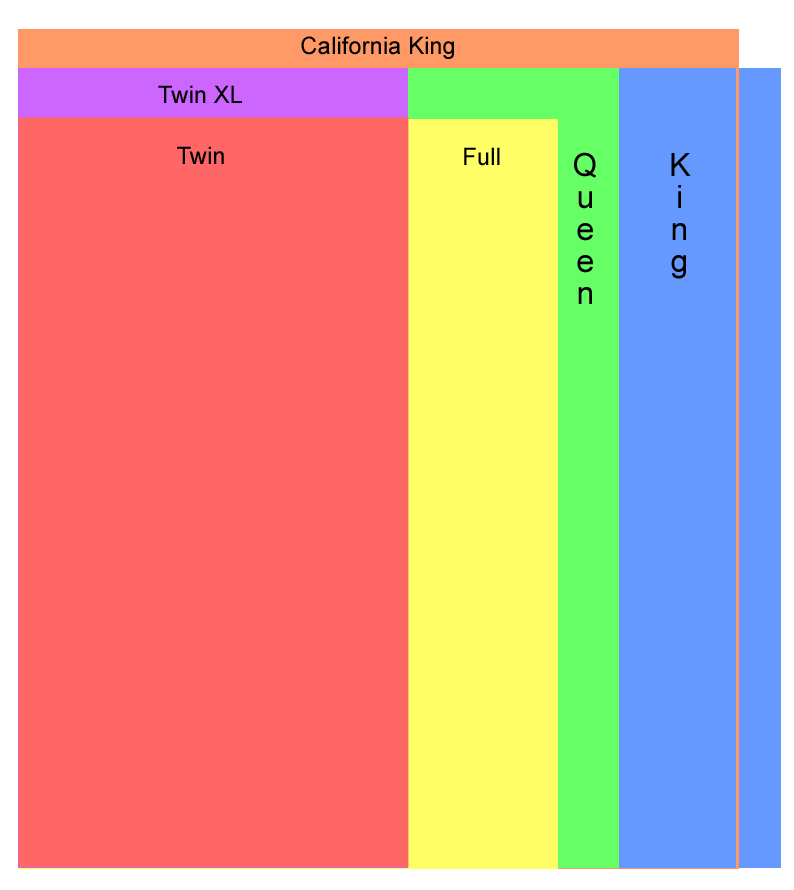
the way it actually works is:
- twin: 3'3" x 6'3"
- full: 4'6" x 6'3"
- queen: 5' x 6'8"
- king: 6'6" x 6'8"
- california king: 6' x 7' (<-- my choice :-D )
house centipede!
only once in my life have i come across this crazy critter that looks a little like a mutated centipede. his legs are too long! apparently confusion over this arthropod is common as 'nobody' has seen one before and 'everyone' is perplexed when they encounter one. i came across mine unmoving on the cement wall in the basement of an old church, and i shocked a friend when i knew exactly the critter being described (once again chillin on a wall)

they are harmless to humans (unlike regular centipedes) and hunt spiders and other bugs.
learn more about scutigera coleoptrata

learn more about scutigera coleoptrata
day length as a function of latitude and time of year
 how cool would it be to live at one of the poles and have only one sunrise and one sunset each year? (i mean, besides the fact that it would drive you nuts)
[via wikipedia]
vibrato and tremolo

what started off over at linguisteresis as a simple inquiry into the difference in definition vibrato and tremolo ended up a full scale investigation.
vibrato is the fluctuation of frequency while tremolo is the fluctuation of amplitude for audio signals. vibrato seems to be more well known because it is considered a good quality to have while singing, yet tremolo is much easier to implement mathematically to a time-varying signal.
i thought a picture would be great to illustrate this difference but wikipedia surprisingly did not have an example, so i made one (seen above) and added it to the page.
im not sure i can really hear the difference between the two so i dove further in by finding a sample audio clip of a (very soprano) operatic singer and viewed her spectrogram (not innuendo.) to me it really just sounds like the sound is getting louder and softer, but what i see is clearly vibrato:
new blog!
my primary passion is electroacoustics, but i realize i frequently post about language oddities, and this is something i have alot of interest in. to accommodate this i created a new blog dedicate to just my random thoughts and observations about language. hopefully others find it interesting also!
http://linguisteresis.blogspot.com/
http://linguisteresis.blogspot.com/
Subscribe to:
Posts (Atom)